
everything you need to know about: Why Italians Don’t Cut Spaghetti
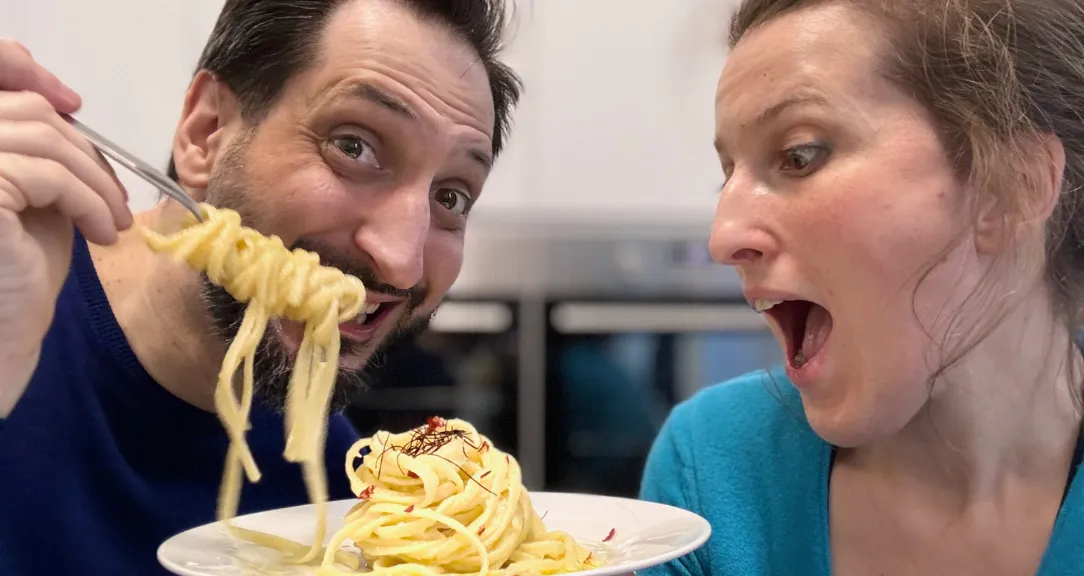
If you have ever been to Italy, you may have noticed something very important at the table.
You can often recognize Italians from people from other countries by one small detail: when they eat spaghetti, or long pasta shapes in general, they don’t cut them with a knife.
But why?
Why don’t Italians cut spaghetti?
Is it just a matter of etiquette, or is there a real reason behind it?
The answer is simple: Here in Italy, spaghetti are meant to be twirled, not cut.
And once you understand why, everything starts to make much more sense.
1. Spaghetti Are Designed to Be Long
Every pasta shape was created with a purpose.
The size, the thickness, the surface, the curve, the hole, the ridge, or the length are never random. Each shape has its own way of holding sauce, moving on the plate, cooking in water, and arriving at your mouth.
Spaghetti belong to the family of long pasta shapes.
Their length is not accidental.
Long pasta shapes like spaghetti, linguine, bucatini, trenette, tagliatelle, and fettuccine are made to be wrapped around the fork. That movement is not just practical. It is part of the eating experience.
When you twirl spaghetti correctly, the strands gather together, hold the sauce, and create a balanced bite. The pasta, the sauce, and the texture arrive together.
If you cut spaghetti into small pieces, you lose part of that beautiful experience that makes spaghetti… spaghetti.
2. Long Pasta Was Once a Sign of Quality
There is also something fascinating about long pasta when we look at the history of pasta making.
In the past, producing long pasta was not easy.
Long shapes like spaghetti required a strong dough structure and careful drying. They had to be handled gently, hung properly, and dried without breaking. A long, straight, intact piece of pasta was something to be proud of.
For pasta makers, long pasta was a kind of test.
If the spaghetti held their shape without snapping during drying, handling, or transport, it meant the pasta had been made well. The dough, the gluten structure, the extrusion, and the drying process all had to work together.
Short pasta, on the other hand, was sometimes connected to broken pieces, cut ends, or smaller formats that were easier to handle.
Of course, today pasta production has changed completely, and short pasta has its own incredible dignity, beauty, and tradition (we love short pasta shapes too) but historically, the length of spaghetti was part of the identity and quality of the shape.
3. Pasta Etiquette Also Plays a Role
There is also another interesting explanation connected to Italian table manners.
In the past, especially in noble Italian banquets, pasta was not always served as a first course the way we commonly eat it today. In some contexts, it was served as an accompaniment to meat or fish dishes.
Think about dishes like capon served on a nest of tagliatelle, or stuffed pasta served alongside roasts. Before the modern habit of eating pasta as a separate first course became common, pasta could appear on the table as part of a richer, more elaborate dish.
And here is where etiquette comes in.
According to one historical explanation connected to Italian etiquette, pasta was served as an accompaniment, almost like a side dish, in noble banquets. Since side dishes were not traditionally cut with a knife, pasta also stayed away from the knife.
Over time, even as pasta became the star of the meal and started being served as a proper first course, the gesture remained. Of course, today we don’t think about noble banquets or nineteenth-century table etiquette while eating spaghetti. But these old habits help explain why, in Italian food culture, the knife still feels out of place when there is a plate of long pasta in front of you.
4. Cutting Spaghetti Is Not a Crime when…
There are only a few situations where cutting or breaking pasta makes sense:
- for very young children
- for soups,
-for specific traditional recipes where broken pasta is intentionally used.
That's it!!
5. What About Breaking Spaghetti Before Cooking?
From a pasta-making point of view, breaking spaghetti before cooking also creates more exposed ends and changes the structure of the strand. This may slightly affect the way water enters the pasta during cooking and how the pasta behaves in the mouth.
There is also a more scientific reason why the shape of pasta matters.
In simple words: the shape and structure of pasta can influence how your body digests it. Some studies have shown that long pasta shapes, such as spaghetti, can produce a lower glycemic response compared to some short pasta shapes, such as penne or macaroni.
Why?
When pasta keeps its long, compact structure, the starch inside is more protected. But when pasta is broken into smaller pieces, especially before cooking, more cut surfaces are exposed.
This means water can enter more easily during cooking, the starch can gelatinize more, and the pasta structure may become easier for digestive enzymes to break down.
This does not mean that one shape is “good” and another shape is “bad.”
Absolutely not.
We love short pasta too.
But it does show us something very important: pasta shapes are not random.
So, what happens if you cut spaghetti?
Let’s be clear. If you cut your spaghetti at home, nobody is going to call the pasta police.
Well… maybe we might look at you for a second. But only with love.
The truth is that everyone can eat pasta the way they prefer.
However, if you want to understand Italian pasta culture, it helps to understand why Italians usually don’t cut spaghetti.
So, why don’t Italians cut spaghetti?
Because spaghetti are long pasta shapes designed to be twirled around a fork.
It is not only about manners... It is about respecting the shape.
Just remember: when you cat Spaghetti you are changing the whole experience.
But now the most important message here is not to turn every plate of spaghetti into an historical, etiquette, and biochemical lesson.
The Pastatarian rule is just one:
Respect the shape, cook it properly, keep it al dente, and enjoy it with the ones you love.
Want to Keep Reading?
Let’s continue this conversation inside the Pasta Fam.
We would love to know: do you twirl your spaghetti, cut them, or secretly break them before cooking?
Come tell us inside the Pasta Fam, where we talk about pasta traditions, pasta habits, and all those little details that make Italian pasta culture so fascinating.
Join the Pasta FAM... here we talk, cook and share a lot pasta!
🔗 Join the PASTA FAM. IT'S FREE!
A big hug
Vallì
Vallì & Dave
We are waiting for you inside.
if you love pasta so much
WELCOME TO THE PASTA LOVERS HOUSE!
Where the magic of homemade pasta brings people together
From our home in Italy to yours... let's keep the traditions of authentic Italian homemade pasta alive, together, like a big family.

Vallì & Dave | We are Pastatarians
We make (and eat) Pasta every single day.
The most entertaining Pasta Experts from Verona. Since 2019, we 've opened the doors of our home in Verona and our Pasta Lovers House, teaching people how to have fun in the kitchen while rediscovering the flavors and tastes of the shape of pasta—within the rhythm of modern life. Welcome home! Discover more


